
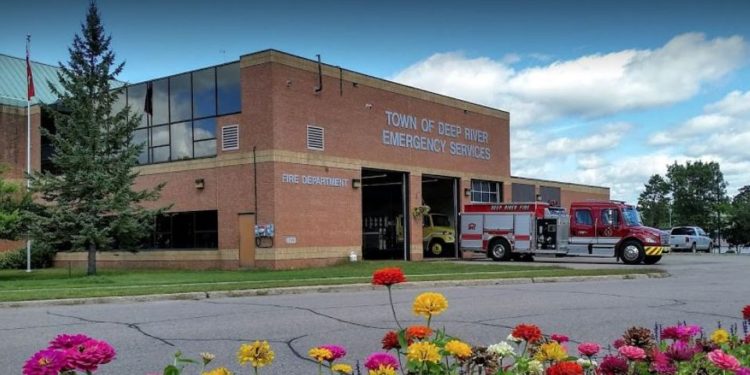
Our fire protection service is inadequate. We need to employ volunteer firefighters to make our community safer, at a substantially lower cost. The union contract stands in the way.
This page posts explanations, documents, and important background references as the situation stood in Fall 2014, when I discussed the Deep River’s need for volunteer firefighters with Wei Chan on CBC Ontario Morning on September 25, 2014. Much of this is still very relevant today (Fall 2017).
Overview
The Ontario Fire Marshall has declared the town’s fire service to be inadequate because we simply don’t have enough firefighters to fully respond to house fires, let alone fires in larger buildings.
An expert review of our needs and circumstances recommended a composite fire department that would provide better protection while saving at least $700,000 per year [see the Dillon report, below]. Three full time firefighters would be deployed to provide better fire prevention, public education, code enforcement, training, and administration. An additional 32 volunteer firefighters would respond to emergencies, a major improvement over today’s model in which only two firefighters are on duty at any given time.
We don’t have volunteers because the union contract was amended in binding arbitration in 1984 to give the union veto power regarding volunteer firefighters (see “no contracting out” language below).
The town tried to negotiate with the union concerning the use of volunteers. To get to the proposed model over time, the Dillon report suggests that the existing full time firefighters be allowed to serve out their careers. Yet even that is not enough for the union, which is ideologically opposed to volunteers. Because no agreement has been reached after nearly three years, the parties must now argue their cases in binding arbitration in October.
Our prospects aren’t promising, however, because binding arbitration has tended to favor emergency service unions over taxpayers (see discussion on “binding arbitration” below). While the arbitration process must be given a chance to deliver a fair decision, it is not too early for the community to consider what to do if the town can’t get the relief it needs or worse, is burdened with yet higher costs.
Statement by Town of Deep River on Fire Department Model
The firefighters’ union “has insisted on proposals that would result in a significant overall increase in the cost of fire services in Deep River. These proposals create further barriers to the use of part-time/on-call firefighters and effectively negate the value of their implementation. We remain hopeful [they] will modify their position for the betterment of our community.” Town of Deep River, excerpt from statement published in the NRT, July 30, 2014. Read the full statement.
The Dillon report: 32 volunteers + 3 full time = A safer community + 60 percent savings
The option being recommended by Dillon Consulting would reduce the fire department’s budget by a massive $709,000, down to just $495,064 – a 60 percent decrease [based on the 2011 budget] that would leave the fire service accounting for just six percent of total municipal operating expenditures. That would also reduce the town’s cost per household for fire protection from $641.52 down to $248.50.
– North Renfrew Times, August 6, 2014
Note: To put the numbers in context, $700,000 is the amount we would save if we had to shutdown the library, the pool and the arena. The fire department is our most expensive service. Its actual operating expenditures averaged $1,400,000 from 2011 to 2013.
Resources:
- NRT article summarizing the Dillon Report
- Dillon Report: Executive Summary
- Dillon Report: key section on the fire suppression model pages 70-96 (electronic pages 82-108 in the full pdf file). Much of the rest of the report deals with other aspects of the department important to fire safety: administration, fire prevention and public education, training, the fire station and equipment, and communication technology.
- Dillon Report: Fire Risk Assessment, Appendix I
- Dillon Report: Economic Considerations, Appendix J
- Full Dilllon Report (Large file warning: 28Mb)
Ontario Fire Marshall reports highlight the deficiency in the current fire suppression model
- OFM Review 2011 – “The OFM evaluation finds that the current fire suppression capability does not meet the needs and circumstances of the municipality. The fire department currently does not have the internal resources to effectively, efficiently, and safely, conduct fire suppression operations at single family dwellings or at any higher risk occupancy” (page 10).
- OFM Review 2006 – The inability to meet standard response times with sufficient fire fighters is discussed on pages 36-37, 40-42. This report suggested an automatic aid agreement with Laurentian Hills was needed to make up for the low numbers of firefighters in Deep River. However, attempts to establish such an agreement ran afoul of the “no contracting out” language in the collective agreement.
“No contracting out” language prohibits volunteers
The collective agreement with the Deep River firefighters contains a “no contracting out” clause that originated from a 1984 arbitration: “Except to the extent and to the degree agreed upon by the parties, no work customarily performed by an employee covered by this agreement shall be performed by another employee of the corporation or by a person who is not an employee of the corporation.”
So in other words, the union can veto the use of volunteers. We’re the only town in Ontario with this precise limitation. Ontario has 460 fire departments, and only 31 of them are entirely full time. Deep River is by far the smallest. Even some large cities like Ottawa and Hamilton use volunteers to supplement their full time force.
While this prohibition on volunteers is extremely inappropriate to the nature of our community, it also contrary to democratic principles. Elected representatives of the people need to be empowered to make decisions about how their fire services are delivered. Yet the power to decide whether to use volunteer firefighters has been taken away.
Binding arbitration favors unions over taxpayers
Having failed to obtain the consent of the union to use volunteers, Deep River now must argue its case in arbitration to amend the “no contracting out” language. Binding arbitration is the process designated by provincial law to settle disputes regarding collective agreements for police and firefighters. For decades, arbitrators in Ontario have favored union interests over taxpayers’ interests. In addition to awarding overly generous wage and benefit increases, arbitrators have limited the ability of municipal Councils to determine the appropriate numbers of firefighters for their communities. The worst example of this is right here in Deep River.
Resources:
- Arbitration Failing Taxpayers – My commentary in the NRT published September 10, 2014.
- This video and more information on how arbitration needs to be made efficient, transparent and accountable is available from the Association of Municipalities of Ontario.
- ESSC Ability to Pay Position Paper – This paper documents how emergency services wage and benefits awards have exceeded other awards, the rate of inflation and the cost of living; how these increasing wages and benefits are not sustainable; how arbitrators and arbitration boards ignore the ability of the municipality to pay in light of its economic situation and the impact on taxpayers who, in essence, are the municipality; and recommends criteria for arbitrators and arbitration boards to consider.
- Two provocative commentaries by Margaret Wente in the Globe and Mail about the escalating costs of firefighters, despite decreases in fires:
Firefighters’ union fights firefighters who volunteer: The “doublehatter” issue
The firefighters’ union in Ontario has been pressuring their members not to volunteer as firefighters in the towns where they live. Recently, the union is trying to have one if its members in Toronto fired for volunteering as a firefighter in Innisfil, a matter which is now heading to arbitration. It has happened here too, where AECL firefighters have been pressured not to volunteer in Laurentian Hills or other local communities.
- Union turns up the heat on firefighters who volunteer on days off: Tom Hunse is fighting to keep his job as firefighter union bylaws in Ontario prohibit members from working at a volunteer force on their days off (Globe and Mail article).
- “These so-called “double hatters play an important role in keeping hundreds of Ontario municipalities safe. They provide fire protection services in small municipalities that do not require and could not possibly afford a fulltime, salaried fire department. They also play a critical role in larger, sprawling municipalities, like Hamilton and Ottawa, where volunteers are needed within their composite fire services… The union is using its power against good people, for political reasons. The union’s position effectively means that firefighters can do anything they want in their free time, except what they are trained to do” (AMO, Sept 10, 2014).
- “A simple change to provincial law would prevent this type of union interference. To our knowledge, every Canadian province has such protection, except for Ontario and Newfoundland. It is time for Ontario to give our volunteer firefighters the same freedom and protection that other employees in Ontario enjoy, as well as those fire fighters everywhere else in the nation” (AMO, Sept 18, 2014)