
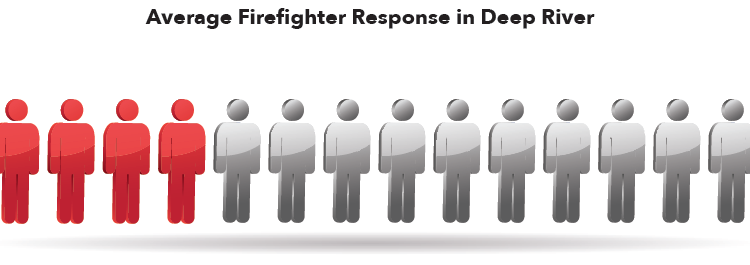
In an online vote, the residents of town of Deep River came out 89 percent in favor of seeking a reduction in full-time fighters and to bring in volunteers, both enhancing safety and reducing cost.
Image: Deep River’s fire response is far from adequate (full background statement)
The official statement from the Town releasing the results, June 21, 2016, says: “Staff will now begin the process to present a compelling position at arbitration with a strong mandate from residents to reduce the number of full-time firefighters from 8 to 2, through attrition, while adding 24 volunteers, creating an effective and affordable Fire Department.”
The option that residents voted for, included “considering steps to transition the existing fire service model to education and prevention only,” if the preferred option is unsuccessful at arbitration (Read the full background statement introducing the online vote).
In the background statement, the Town released data that show that despite the very high cost, the current fire protection is not protecting its citizens:
To meet the requirements outlined by the OFM, the minimum number of firefighters required to effectively conduct interior fire suppression at a moderate-risk occupancy is 16. For high-risk occupancies, a minimum of 24 firefighters are needed. In comparison to the actual number of firefighters, including the Fire Chief, currently available within the Town of Deep River (9.6), this represents a deficiency of 6.4 firefighters in order to achieve the lowest level of efficiency at moderate-risk occupancies.
In addition to this, for the period of 2007 to 2011, the average response to a fire call by the Town’s fire suppression service was less than 5 full-time firefighters including the Fire Chief. This indicates that for this period, the average response was less than 3 of the 7 available off-duty firefighters. This represents a deficiency of 11 firefighters in order to achieve the lowest level of efficiency at moderate-risk occupancies.
At the same time, the town reported: “According to the Ontario Ministry of Municipal Affairs and Housing’s Financial Information returns (FIRs), each household in Deep River paid more for its fire department in 2014 than any other household in Renfrew County by more than double.”
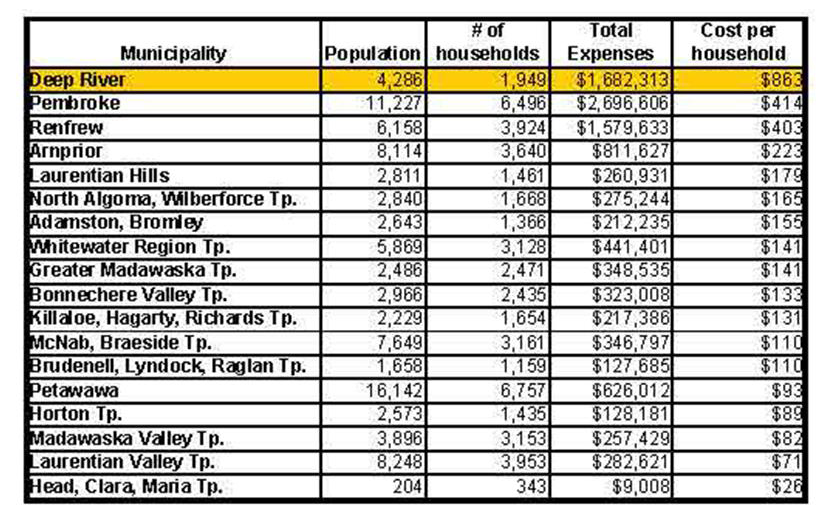
Deep River has more than double the cost per household of its neighbors (full background statement)